ValuePhile

  • Bank of America’s Silent Tailwind

    May 4th, 2025

    *this article was orignially published July 14, 2024*

    Bank of America ($BAC) often draws outsized criticism, especially across finance and crypto communities on platforms like Twitter/X. A quick search of the $BAC cashtag reveals constant calls for doom—particularly around earnings season or macro stress events. Much of this skepticism centers on a specific accounting issue: Bank of America’s large held-to-maturity (HTM) portfolio of agency mortgage-backed securities (MBS), which has, at times, shown over $100 billion in unrealized losses on a mark-to-market basis.

    Despite this negative sentiment, Bank of America is the second-largest position in my equity portfolio.

    Why the Bearish Sentiment?

    BAC represents traditional banking, and that alone makes it a target in today’s fintech-driven narrative. Ironically, BAC executes many fintech functions more reliably than the startups that criticize it—many of which depend on traditional infrastructure behind the scenes. Crypto enthusiasts, too, often view large banks as barriers to the adoption of digital assets and cheer on any perceived weakness.

    However, the crux of the bearish case typically revolves around the accounting treatment of BAC’s HTM securities and the hypothetical risk that a deposit run—like the one that toppled SVB—could force the bank to realize large losses.

    Is BAC Vulnerable?

    In theory, yes—any bank forced to liquidate long-duration assets during a crisis could face steep losses. But Bank of America is not SVB. Its deposit base is far larger, more diversified, and more stable. In times of market stress, deposits tend to flow toward systemically important banks like BAC, not away from them.

    The current situation stems from the early pandemic period. The U.S. government injected trillions into the economy while consumer spending and business investment stalled, leading to a surge in bank deposits. BAC alone saw about $1 trillion in inflows. Lacking lending opportunities, the bank allocated roughly half of this capital to short-term instruments and the other half to long-term agency MBS.

    The Impact of Rate Hikes

    This MBS portfolio—currently around $458 billion—was mostly purchased when yields were just above 2%. With the Federal Reserve’s aggressive rate hikes, the market value of those bonds has dropped, creating large unrealized losses.
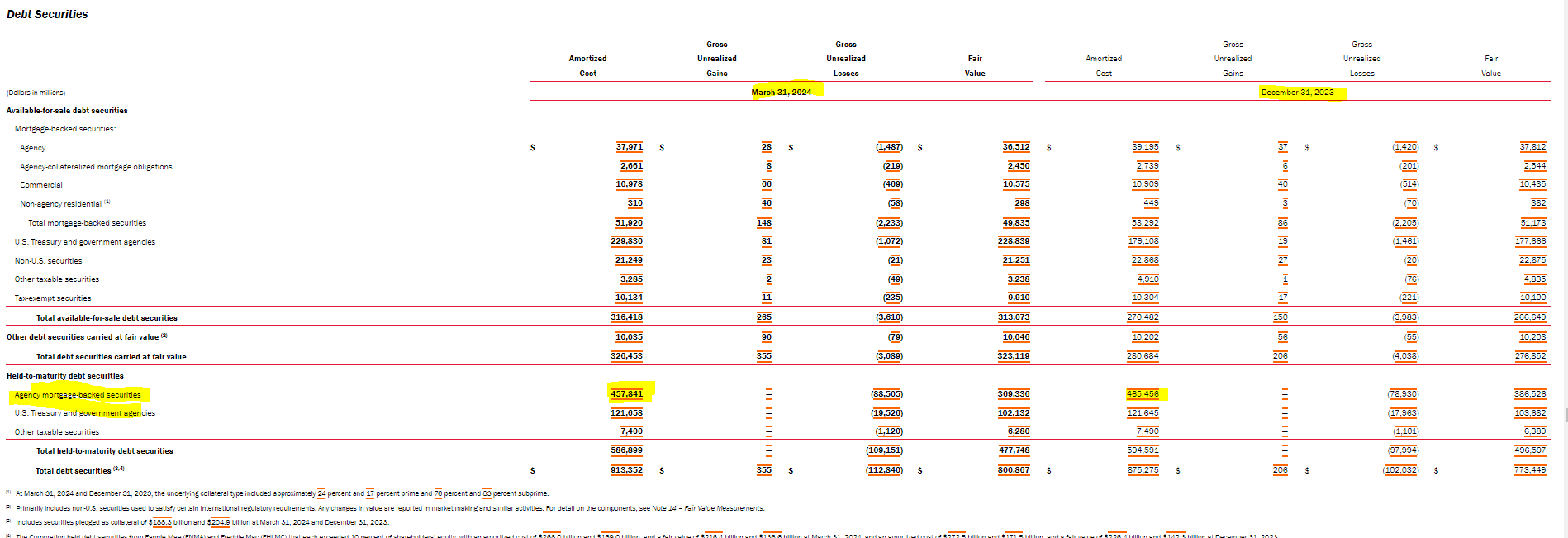
    Bank of America Debt Securities summary from March 31, 2024 quarterly report.

    But under IFRS, HTM securities don’t need to be marked to market as long as the bank intends to hold them to maturity. These are government-backed assets, and unless forced to sell, BAC can ignore those paper losses. This frustrates critics, but it’s standard accounting. These losses aren’t economically meaningful unless liquidity dries up—which, again, is highly unlikely for a bank like BAC.

    A Hidden Advantage

    Here’s what many critics overlook: Bank of America’s long-dated MBS portfolio could become a structural tailwind as rates remain elevated.

    Roughly $10 billion of these HTM securities mature or are prepaid every quarter. That capital is now being reinvested in instruments yielding over 5%—primarily T-bills. This represents an uplift of over 3 percentage points versus the original MBS yield.

    At ~$40 billion reinvested annually, BAC effectively improves its net interest income each quarter—without any operational change.

    Over a decade, this rotation could increase earnings per share (EPS) by roughly $0.14 per year, assuming stable rates. This is a material tailwind for a bank with stable operations, a growing deposit base, and the ability to repurchase shares.

    What I’m Doing

    My average cost on BAC is around $28. I increased my position substantially during the 2023 panic after SVB’s failure, when BAC briefly traded near $25. At current levels (~$41), I’m more cautious, but still bullish over the long term.


    Final Thoughts

    BAC continues to operate efficiently. If the bank maintains discipline and redeploys capital intelligently, the embedded tailwind from its maturing MBS portfolio could unlock significant value—especially if shares are repurchased at reasonable prices.

    Disclaimer

    I’ve made a ton of assumptions here and this isn’t meant to be investment advice to anyone. In fact I’m not sure I’d buy more BAC at this price, but it’s hard to tell because of where my average cost is. There are a ton of things that could happen to make my observation here irrelevant. Huge recession, trade war, civil unrest. Heck, there COULD be a run on Bank of America. It seems pretty unlikely to me but you get the point. Take the above with a grain of salt.

  • An Emerging Market Lesson

    October 29th, 2023

    I learned a tough lesson the morning of October 5th.

    Waking up late (the reason escapes me now, I believe I was off work) I noticed my portfolio slightly diverging from the markets enough for me to question what was going on. I run a very concentrated portfolio of individual stocks but it’s still fairly rare to see tracking error (especially at market open) of more than 50bps unless some news or special dynamic is occuring.

    A few seconds later I got the notification (PAC down more than 5%), so I flipped to my stock tracker to see how bad it was. Grupo Aeroportuario del Pacífico (PAC) is a Mexican airport operator that trades on the American Market via ADR.

    The stock had gapped down from ~$163 to ~$117 at market open. Shit. The government of Mexico had informed airport operators that day that they decided to unilaterally alter the tarrif’s they were charging these operations. This meant there was going to be a direct margin hit on their operating model. Even worse, the government didn’t provide any details on the size of the change and neither did the operators, indicating they would give details in their next quarterly update.

    Darth Vader comes to mind “I am altering the deal, pray I do not alter it any further.“

    A Warning Shot

    Several months prior, Citigroup had been trying to sell its Mexican retail banking operations. There were several bidders but the process slowly over time was showing more and more red flags. Initially quite a few bidders, then Andrés Manuel López Obrador (or AMLO as journalists call him) and the government of Mexico started talking about their requirements. At first fairly reasonable.

    But this continued on, and it became evident that Mexico was not going to let the free market decide the outcome of this bidding process. Nonetheless Germán Larrea of Grupo Mexico was the winning bidder and things were looking okay, but dragging out longer than expected. During this entire time Citigroup continued to reiterate to investors that it was pursuing a dual path of direct sale or IPO for its Mexican banking operations.

    After radio silence for a while, the government of Mexico expropreated a railway owned by Larrea. Not a good sign.

    Sure enough shortly thereafter Larrea backed out of the sale. No surprise, its likely the delay was Larrea trying to negotiate with AMLO’s government on the side on how they would get their cut.

    Shortly after Citi announced their intention to IPO the business. It’s likely they knew this was a risk from the start and this is why they always mentioned that path as a possibility.

    Good Instincts, Unfortunately I didn’t Listen

    After this occured I began to think a bit about PAC. The airport operator was such a fundamentally sound business. A true monopoly with growing demographics and exploding flight volumes out Mexico (a trend likely to contunue). They had amazing returns on invested capital, and growth was structurally guarenteed. It was a true winner and great business. It had also been my best performer by far the past few years up over $200 I believe at one point from my cost basis of ~$85.

    More painful even was that it was a stock I discovered myself.

    After the Citi issues, I questioned in the $190’s if I should cut the position, was it a risk that the AMLO issue could expand to other industries? Should I cut and run with a great gain? I knew from experience that selling a great business was often a misstep.

    I kind of delayed really thinking about this (and by default choosing not to make a change) and paid the price.

    Ouchie

    I sold all my PAC shares that morning after the gap down at about $115. An overall gain of about 35% + dividends over a few years. Not terrible but not good and certainly not the 25%+ compounded I had before. I had to be decisive and immediately realized the lesson. This was a type of investment I could no longer operate with confidence in.

    In subsequent days the stock went back up as high as $135.

    At their quarterly report PAC gave details on the unilaterally renegotiated tarrif’s and the stock is now trading at $105 or so. All in all around 5% more of their revenue would be taken directly by the government because they felt like it. Brutal.

    At the end of the day my PAC position wasn’t large with respect to the overall size of my portfolio at around 1.5% of AUM prior to the decline, but this was painful.

    Going Forward

    An important and perhaps obvious lesson here was learned. It is dangerous to invest in countries where rule of law and leadership are not respectful of investor rights. I probably won’t directly invest in a fully Mexican business again in the future after this lesson, or any Emerging Market local businesses for that matter. Now I see why. In theory I’m sure I’ve read the warnings before, but to see it play out in real life is different.

    With respect to Citigroup, the entire business is fundamentally so cheap I think this concern doens’t break the thesis. AMLO as well has to keep in mind the impact that continually underminding investors would have on Mexico’s economy.

    Citigroup is such a large and important American business don’t expect that AMLO would try to interfere too much with the IPO process. I think at a certain point Citi’s US Government lobbiests would have some discussions with contacts in the AMLO governmenet and give some warning shots on implications of continued meddling. I also expect lobbiests for Citi are fairly well versed in dealing with the realities of the government there. But obviously there is risk.

    Hopefully this experience is one I can grow from. A great investment turned into an okay investment and a lesson to look back on.

  • Why I’m Long Citigroup

    February 4th, 2023

    For years Citigroup has been one of the most hated stocks in the market, and being honest, much of that derision was well earned. But has something changed?

    In the past few decades Citi has suffered from a seemingly continual stream of unforced errors. Currently they are under a consent order related to their risk management and internal controls and they are paying expenses through the nose to address these concerns. Any articles about the company on sites such as SeekingAlpha come with a barrage of comments mocking the company’s past failures and questioning why anyone would touch it as an investment after many were wiped out owning its shares during The Great Recession.

    In Steps Jane Fraser as CEO

    For decades, Citigroup has suffered from a lack of clear strategy or direction. A fundamental shift in the business occurred the day that Jane Fraser took over. Lots of CEOs talk a big game, make nice slide decks and talk about the future and how great it will be. But there is a big difference between management and GREAT management.

    It takes a very unique sort of individual to admit when a business needs to get smaller. Many CEOs are obsessed with empire building and expanding businesses, but the truth is that sometimes the correct plan is to exit bad verticals and get smaller and have a clear focus. These are hard decisions to make, and most mediocre CEOs are unwilling to make drastic changes. Most are there to collect obscene pay for a few years and move on.

    Immediately upon starting, Jane began work selling off not just struggling consumer banking units, but effectively all consumer banking units at Citi outside the USA. This is now a well known topic for bank leadership. It is extremely hard to succeed efficiently in retail banking outside your own country. Instead of allowing mediocrity to continue, these business have been sold rapidly, one after the other, freeing up valuable capital and leaving a more focused and nimble bank.

    Fundamentally this is the most profound and important recent change at the bank.

    Post GFC Banks

    Beyond leadership, I believe there still exists fundamental misunderstanding of the large US banks since the end of the great financial crisis. Many investors (especially those who don’t follow closely) still see these businesses as extremely reckless, levered high risk operations just waiting for the next 2008 to come.

    Truthfully, the huge amounts of regulatory oversight and changes that occurred post GFC have largely neutered banks. Systematically important banks are subject to extremely onerous and robust regulation and risk monitoring. They were forced to wind down or sell risky units and in my view are becoming more and more like utilities.

    As part of the annual CCAR (Comprehensive Captial Analysis & Review) large banks are required to simulate and prove to regulators that even in very extreme scenarios they would have sufficient loss absorbing capacity to protect the financial system. This includes strict regulatory minimums on Tier-1 capital levels. Banks are mandated to operate conservatively through this regulatory process.

    Additionally banks are also required each quarter to book CECL (Current Expected Credit Loss) provisions each quarter in which they must immediately reflect any and all future expected credit losses as an expense on the income statement for the current quarter. Wondering why bank EPS are so volatile lately? This is why.

    The robustness of banks (including Citigroup) is further demonstrated by their continued profitability at historically unprecedented low interest rates for years. Finally after years of (frankly reckless) monetary policy, rates are moving back to reality. This isn’t as large a factor for Citi as a money center bank but makes a big difference for the likes of Bank of America with its robust deposit base.

    In terms of credit, many view Citi as risky due to it’s international exposure which is of course somewhat true and makes it unique among American Banks. However it should be noted (as they highlight on every earnings call), most of their credit relates to multinational companies who operate internationally. I think this risk is somewhat overweighted by many investors.

    That being said, there are of course very real and tangible risks unique to Citi. It is more exposed to international business and credit cards, and so these factors must be weighed when considering the stock.

    Ok, So What’s the Catalyst?

    Before I get into what I think the catalyst here is, let me be clear: there is a reason Citigroup currently trades where it does. Citi trades well below its Tangible Book Value Per Share of $81.65 as of December 31st. The company’s Return on Tangible Common Equity (RoTCE) is much lower than a lot of it’s peers. And so the discount to Book Value is not unjustified.

    Capital Levels

    As of December 31st Citi announced they had hit their target Tier-1 capital level of 13% which is a key accomplishment. This is the level of capital where Citi would be able to begin repurchasing its own shares, which (as you can imagine) is unbelievably accretive when your stock is trading at 63% of Tangible Book Value.

    Every share repurchased is immediately increases book value, and reduces the amount of capital used in dividend payments.

    Investors were disappointed to learn that Citi is not yet buying back shares. The issue stems from its (hopefully) upcoming sale of Citibanamex. This sale which is speculated to bring in anywhere from $7-12B (I’m guessing on the lower end) results in some temporary reductions in Tier-1 capital due to accounting stupidity that will reverse out if the deal closes later on. But alas, they are not yet able to buy back shares. It’s still possible the Citibanamex sale does not occur as expected, but if it does Citi will have a huge amount of capital to deal with very shortly.

    Expense Right-Sizing and (hopefully) Efficiency Gains

    Citibank is currently spending way above trend in order to address its Consent Decree related to risk management systems. In theory these expenses should right-size over the next few years leading to increased profitability and RoTCE all else equal.

    Additionally, Citigroup has sold many consumer banking franchises and as these businesses complete separate in the coming years, efficiency of the overall organization should increase as its capital allocation becomes more efficient.

    Treasury and Trade Solutions (TTS)

    TTS is considered the crown jewel of Citi by many. As I’m not intimately familiar with TTS on its own I’ll leave that for you to read more on. Suffice to say that Citi’s unique capabilities to move money around a massive number of nations for Multinational companies is a unique and valuable toolset.

    The business has been growing significantly and I’ve read opinions that TTS alone could be worth more than the entire Market Cap of Citibank currently. I don’t know enough to agree or disagree but the business is exciting.

    Improvements in Investment Banking

    Obviously it’s been a rough go for certain business with overnight rates skyrocketing over the past year. When the dust settles, investment banking deals should return at some point helping the bottom line.

    Final Thoughts

    When a business with a cheap valuation (~0.6 TBV), consistent profitability, moat and exciting growth (TTS) gets new leadership (Jane Fraser) who is focused, effective and works with urgency I take note.

    I think the current valuation, prospect of upcoming accretive share buybacks and capital return as well as potential for efficiency gains over the coming years makes this a compelling opportunity for my portfolio. I currently own the stock with the intention to hold long term.

    Disclaimer

    Please note, the above commentary relates to my personal portfolio and is not to be considered investment advice. You should consult an appropriate professional when making financial decisions and not strangers (like me) on the internet.

  • Refocusing on Value Investing

    December 4th, 2022

    For various personal reasons I’ve had to discontinue some of my earlier work I had published on this blog. Primarily my career is taking up more of my time so I have limited spare time to work on side projects. For that reason I’ve deleted a lot of old posts on work that won’t be continued.

    I’m going to be focusing this blog on Value Investing again. I’ve launched a Twitter where you can follow me @ValueDoug where I’ll keep my day to day thoughts. This blog will be reserved for long form research, thoughts and analysis.

    If you are new here welcome! Hope you consider giving my Twitter a follow as I try to provide thoughtful insights and analysis through this forum.

  • The “TOO HARD” box

    February 2nd, 2022

         Last week I watched interview from CNN where Poppy Harlow was given a tour of Warren Buffett’s office. I was looking for some grounding, some stability in a world and market that seems so unstable right now. Something about the casual, down to earth attitude of Buffett is comforting. Near the end of the clip, Poppy pointed to a black paper basket on the desk with big red letters on the end reading “TOO HARD”.

    “There’s a lot of things that belong in there. The real problem is if they belong in there and I don’t realize it.” – W.B

         My portfolio has performed well in the recent volatility of 2022 and over the past two years. The S&P 500 and NASDAQ composites ended January Down ~5% and ~10% respectively, while I’m up modestly during this period. The COVID era provided an opportunity for me to back up the truck on some conviction picks and this has benefited my returns greatly the past 2 years. These stocks are very positively sensitive to short term interest rates, so current Fed hawkishness is a potential catalyst for me. But fundamentally they are sound businesses that should provide respectable return in most environments and were way too cheap.

         The “too hard” basket resonated with me though. Investing has felt too hard for a while. Aside from a few conviction holdings it has been difficult to find interesting opportunities. Liquidity has raised prices to a point that’s felt unsustainable. Speculation is running rampant because there is no real yield to be found in most areas. Some positions I’ve scaled into have done well but become too expensive to continue building positions. And most difficult of all, my exposure to conviction names is too large to build further from a risk management perspective.

         Government insistence on unlimited QE and liquidity has made winners out of the most suspect of speculations. Profitability no longer seems to matter. Everyone and their cat have gotten rich because there are no consequences when money is free. Everyone except value investors of course, and the bulk of people in the world who don’t own stocks or a home. This feels unfair even though I know it isn’t, it’s just a reality I didn’t understand before. I’ll take the lesson of bad incentives with me the rest of my life.

         But its time to refocus. I started that process this week, forcing myself to write a small thesis on why I owned every position I hold. Largely I was able to do so. But I found some stocks I owned where the “too hard” market had fogged my judgement. Why did I own these companies? Sure, they were well run, and cheap, but I didn’t understand the industry well. When I asked myself why I owned them I couldn’t come up with much beyond “they are cheap”. Not good enough.

         I acted. I sold them all. It’s easy to think you are investing soundly but it requires discipline. I don’t want to let market apathy haze my judgement. My cash allocation increased ~3%. For now these are back in my “too hard” pile, because what I don’t know I don’t know is the biggest risk.

         We’re on the cusp of a return to sanity, I hope. Powell and the Fed have clearly indicated overnight rates are likely to increase in March, and QE will end. QT will begin shortly thereafter. The free money crowd is adamant that the yield curve will invert, and we will be in a recession again shortly. It’s possible, but hopefully not, especially for the sake of everyday people. Either way my focus will continue be on owning great businesses at fair prices.

Blog at WordPress.com.


Loading Comments...
 

    • Subscribe Subscribed
      • ValuePhile
      • Already have a WordPress.com account? Log in now.
      • ValuePhile
      • Subscribe Subscribed
      • Sign up
      • Log in
      • Report this content
      • View site in Reader
      • Manage subscriptions
      • Collapse this bar